


 Cart
Cart
 sales@molnova.com



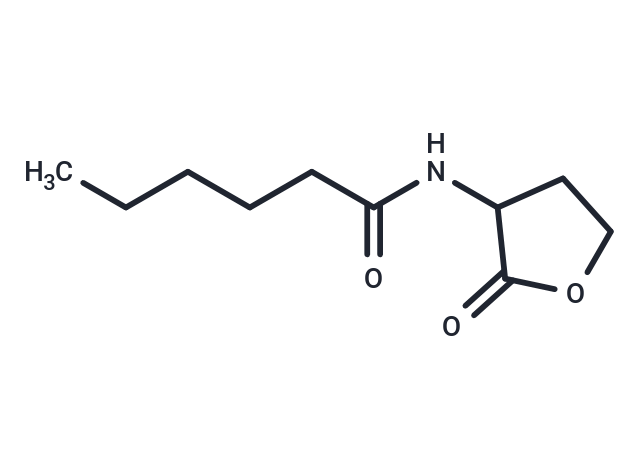
N-hexanoyl-DL-Homoserine lactone
CAS No. 106983-28-2
N-hexanoyl-DL-Homoserine lactone( —— )
Catalog No. M34979 CAS No. 106983-28-2
N-hexanoyl-DL-Homoserine lactone (C6-HSL), isolated from bivalve larval cultures, degrades bacteria and inhibits lesions induced by the phytopathogenic fungus B. cinerea.
Purity : >98% (HPLC)
 COA
Datasheet
HNMR
HPLC
MSDS
Handing Instructions
COA
Datasheet
HNMR
HPLC
MSDS
Handing Instructions
| Size | Price / USD | Stock | Quantity |
| 5MG | 38 | Get Quote |


|
| 10MG | 61 | Get Quote |
|
| 25MG | 119 | Get Quote |
|
| 50MG | 196 | Get Quote |
|
| 100MG | 295 | Get Quote |
|
| 500MG | Get Quote | Get Quote |
|
| 1G | Get Quote | Get Quote |
|
Biological Information
-
Product NameN-hexanoyl-DL-Homoserine lactone
-
NoteResearch use only, not for human use.
-
Brief DescriptionN-hexanoyl-DL-Homoserine lactone (C6-HSL), isolated from bivalve larval cultures, degrades bacteria and inhibits lesions induced by the phytopathogenic fungus B. cinerea.
-
DescriptionN-Hexanoyl-DL-homoserine lactone is a bacterial quorum sensing molecule produced in the rhizosphere. N-Hexanoyl-DL-homoserine lactone, a bacterial quorum sensing signal, induces transcriptional changes in Arabidopsis and may contribute to tuning plant growth to the microbial composition of the rhizosphere.
-
In Vitro——
-
In Vivo——
-
Synonyms——
-
PathwayMicrobiology/Virology
-
TargetAntibiotic
-
RecptorAntibiotic
-
Research Area——
-
Indication——
Chemical Information
-
CAS Number106983-28-2
-
Formula Weight199.247
-
Molecular FormulaC10H17NO3
-
Purity>98% (HPLC)
-
SolubilityIn Vitro:?DMSO : 100 mg/mL (501.88 mM; Ultrasonic )
-
SMILESCCCCCC(=O)NC1CCOC1=O
-
Chemical Name——
Shipping & Storage Information
-
Storage(-20℃)
-
ShippingWith Ice Pack
-
Stability≥ 2 years
Reference
1. von Rad U, et al. Response of Arabidopsis thaliana to N-hexanoyl-DL-homoserine-lactone, a bacterial quorum sensing molecule produced in the rhizosphere. Planta. 2008;229(1):73-85.?
molnova catalog



related products
-
CCR-11
CCR-11 is a tannin-containing derivative with antimicrobial activity. CCR-11 inhibits the proliferation of B. subtilis and HeLa cells.
-
BMS626529
BMS-626529 is a novel attachment inhibitor that targets HIV-1 gp120 and prevents its binding to CD4+ T cells.
-
Cefazaflur
Cefazaflur is a novel semi-synthetic cephalosporin derivative that can be used as an Antibiotic agent.
